A response to Paul Krugman’s column
“The Dollar’s Special Status: Sources and Threats”
April 2026
Paul Krugman’s recent column on the international role of the US dollar is an accomplished piece of applied economics. He marshals a great deal of evidence efficiently, his empirical command is not in question, and his conclusion — that dollar dominance will not collapse any time soon — is probably correct. I find myself in agreement with much of what he argues about the current state of affairs. What I take issue with is the foundation on which the analysis rests: an account of what money is that economics has been repeating, with remarkable fidelity, since Adam Smith. It is a story that is elegant, internally coherent, and, in all the ways that matter, wrong.
This is the first of two posts examining that foundation. Here, I address the standard mythology of money itself. In a second post, I will turn to Krugman’s account of why the dollar dominates the global economy, and to what that dominance actually reveals about the nature of economic power in the twenty-first century.
I should be clear from the outset that Krugman is not the target of this critique in any personal sense. He is an exceptionally clear and honest expositor of the mainstream economic view. That is precisely what makes his column a useful entry point: in setting out the standard account of money as carefully as he does, he illustrates with unusual transparency what that account contains, and what it conspicuously leaves out.
I. The Three Functions and the Myth of Barter
Krugman opens his theoretical discussion with a visit to a Second World War prisoner of war camp. In the camps, he notes, cigarettes emerged spontaneously as money. With no government to mandate a medium of exchange, the prisoners nonetheless converged on a common currency, one that fulfilled — as economics texts have always required — the three canonical functions: medium of exchange, store of value, and unit of account. The story is due to R. A. Radford, whose 1945 article in Economica, “The Economic Organisation of a P.O.W. Camp”, remains one of the most cited pieces in introductory economics teaching. It is not hard to see why: the camp provides what Radford himself called a living alternative to the Robinson Crusoe economy beloved of textbooks — a small, tractable economy in which the fundamental logic of markets can be observed in miniature.
I now turn to why this story, appealing as it is, does not do what it is supposed to do.
The three-functions account of money is inseparable from a specific origin story: the myth of barter. The standard narrative, which goes back through generations of textbooks to Adam Smith’s Wealth of Nations, runs as follows. Human beings have a natural propensity to exchange. In a purely barter economy, exchange is obstructed by the problem of the double coincidence of wants: I have apples and want bananas; you have bananas and want something entirely different. The resulting search problem is so severe that trade would barely occur at all. Money solves this problem. It emerges — either spontaneously, through the game-theoretic convergence of self-interested agents, or by collective convention — as an intermediary good, one that everyone accepts not because they want it for its own sake but because everyone else accepts it. Once this intermediary exists, the three functions follow naturally: money is a medium of exchange (it resolves the double coincidence), a store of value (it can be held between transactions), and a unit of account (prices are expressed in its terms).
This is a story of considerable analytical elegance. The problem is that it has no historical foundation whatsoever. As the anthropologist David Graeber documented at length in his 2011 book Debt: The First 5,000 Years, no economist, explorer, or archaeologist has ever found the fabled barter economy from which money is supposed to have emerged. Graeber pointed out that for over a century, anthropologists had been unable to locate any actual society in which complex barter — strangers trading commodities with strangers at arm’s length, without prior relationship or credit — was the primary mode of economic organisation. The absence of evidence has not discouraged economists from citing the story with confidence; but absence of evidence, in this particular case, has accumulated to the point where it constitutes, rather more uncomfortably, evidence of absence.
The deeper point is this: the barter-origin myth does not describe a historical sequence. It describes a logical structure. Economists are not, in fact, making a claim about what happened in prehistoric Mesopotamia or ancient Greece; they are constructing a thought experiment to motivate the concept of money. One is tempted to conclude that this distinction does not matter — and on this occasion I shall resist the temptation. It matters enormously, because the logical structure encodes a set of assumptions about human beings and their social arrangements that are themselves quite specific, and quite contestable.
II. The Problem with the Prisoner of War Camp
I now turn to the Radford myth more directly, because it is more subtle than the barter story and, for that reason, more instructive in what it conceals.
The POW camp example is presented as an instance of money emerging spontaneously from trade, without any state apparatus to mandate it. This is supposed to demonstrate that money is a creature of the market, not of the state — that it arises naturally wherever there are human beings with things to exchange. The argument has a certain appealing generality: if it works in a prison camp, it must reflect something deep and universal about human economic behaviour.
It is important to realise, however, that the prisoners in Radford’s camp were not a representative sample of humanity. They were, overwhelmingly, educated mid-twentieth-century men who had grown up in fully monetised economies, who had handled coins and banknotes every day of their adult lives, who knew perfectly well what money was and how it worked. When cigarettes emerged as a medium of exchange, this did not represent the spontaneous discovery of the concept of money by agents who had never encountered it. It represented the application of a concept they already possessed to a new and inconvenient set of circumstances. The experiment demonstrates that money-literate individuals, placed in an environment without their usual currency, will find a substitute. This is interesting, but it is not the same thing as demonstrating that money arises spontaneously from barter in a pre-monetary society.
Consider, for a moment, a rather different thought experiment. Suppose one populated the camp not with 1940s British officers but with seventeen-year-olds from 2026, none of whom has ever handled physical currency, all of whom transact entirely through contactless cards and mobile payments. Take away their devices and throw them into a camp. Would money — in the commodity sense — emerge? Would they converge, through a process of strategic complementarity, on some common medium of exchange? Perhaps they would, eventually. But it is far from obvious that the convergence would be rapid, automatic, or that the resulting institution would resemble commodity money at all. They might, for instance, settle on systems of mutual obligation, reciprocal favour, and deferred credit — which is, as we shall see, a great deal closer to what the historical record actually shows.
There is a second limitation to the Radford story that is equally important. A prisoner of war camp is not merely a small economy; it is a dense social community. The prisoners know one another, develop trust relationships, and are embedded in an existing social structure — rank, nationality, shared experience. The emergence of a monetary convention in such a community tells us, at best, something about how shared norms arise among a small, homogeneous group with pre-existing social bonds. It is, in this respect, rather similar to what happens in any small community — a village, a tribe, a neighbourhood — where informal arrangements of exchange are stabilised by personal knowledge and trust. The problem for the standard myth is that these are precisely the conditions under which barter can work perfectly well without money, and in which the search problem is tractable without any special intermediary. The Radford camp, in other words, illustrates money emerging in exactly the conditions where it is least needed as a theoretical solution to the double coincidence problem.
III. The Human Being as Networker, Not Atom
The mythology of barter and the three-functions account of money rest on a particular image of the human economic agent: an isolated individual, in possession of a bundle of goods, seeking to trade with strangers at arm’s length in a market that has somehow already come into existence. This individual has no prior relationships, no social context, and no history. The market is simply there — as if it had descended, in Krugman’s own phrase, from nowhere — and the individual participates in it according to the logic of self-interest.
The main insight here is that this image is not a simplification; it is a distortion. The anthropological and historical evidence points in a quite different direction. Human beings are, first and foremost, social animals — networkers, in the most fundamental sense. They do not trade as isolated atoms; they trade as members of communities, and those communities precede, and make possible, the exchange relationships within them. Trust is not a by-product of repeated market interaction; it is a precondition for any economic interaction at all.
At the level of the prehistoric tribe — the social unit within which most of human economic life was organised for most of human history — the dominant mode of economic organisation was not barter between self-interested individuals but communal sharing within a group bound together by kinship, obligation, and mutual recognition. Outputs were shared, contributions were collective, and there was no sharp distinction between what was mine and what was ours. Property rights, in the sense presupposed by market exchange, were absent or attenuated. The notion that such communities would solve their allocative problems by converging on a commodity money through strategic complementarity is, to put it gently, not supported by the evidence.
It is also worth noting — because it is a detail the standard account tends to find equally uninteresting — that this communal mode of organisation is not some primitive precursor to the real economy. It is a coherent and, in many respects, remarkably effective way of coordinating economic activity among people who know and trust one another. The market, when it eventually appears, appears not as the natural condition of economic life but as a solution to a specific problem: how to organise economic activity among strangers, people who do not share the bonds of kinship and personal trust that make communal arrangements work.
IV. The Agricultural Empire and the Invention of the Stranger
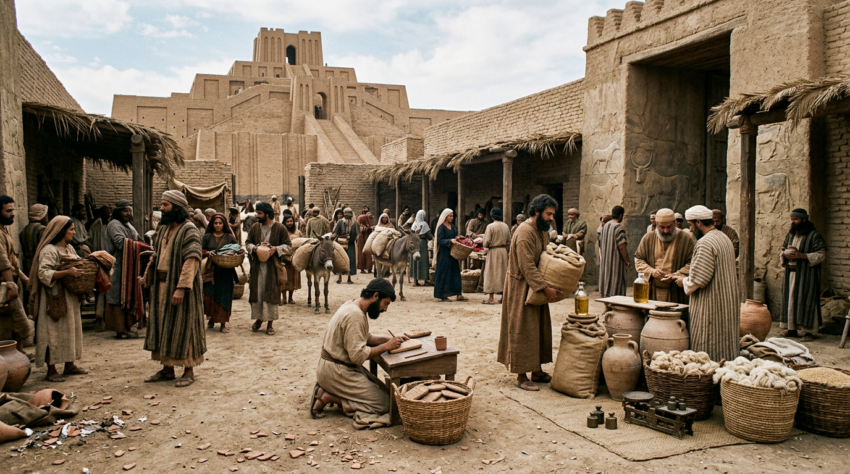
The decisive transition in economic history — the one that the standard mythology of money most conspicuously fails to account for — took place roughly five thousand years ago, in the agricultural empires of Mesopotamia. It was here, for the first time, that human economic activity extended systematically beyond the tribe: that transactions occurred between people who did not know one another, who had no prior relationship, and who could not rely on personal trust to sustain their exchange.
This transition required new instruments. The two most important were, first, the state — a political institution powerful enough to create and enforce the rules that make transactions between strangers possible — and, second, property rights: the codified recognition that certain goods and certain parcels of land belong to certain individuals, and that this belonging is backed by the coercive authority of the state. Markets, in this account, are not a natural phenomenon that the state subsequently regulates. They are a creature of the state, dependent on the institutional infrastructure that only a state can provide.
The second instrument, and the one most directly relevant to the question of money, was debt. This is where the research of Michael Hudson becomes indispensable. Over four decades of collaboration with the Harvard Peabody Museum, Hudson and his colleagues have documented the economic organisation of the Mesopotamian temple economies of the third millennium BC in remarkable detail, drawing on the cuneiform tablet records that survive in extraordinary abundance from this period. The picture that emerges is one in which debt, not exchange, is the primary economic institution. Hudson’s trilogy — beginning with …and forgive them their debts (2018) — represents the most sustained and empirically grounded challenge to the standard account of money’s origins that currently exists.
The Mesopotamian temple economy was organised around the palace and the temple as central administrative institutions. Farmers and craftsmen received inputs — seed, tools, draught animals — from the temple on credit, and incurred obligations to return a portion of their output as repayment. These obligations were recorded on clay tablets, and the accounting unit was barley — the staple crop of the agricultural economy. Silver served as a secondary standard for larger transactions and long-distance trade. The critical point is that money in this system was not a medium of exchange that emerged from barter. It was, fundamentally, a medium for the settlement of debt. The primary economic relationship was not the spot trade of goods between independent agents; it was the ongoing relationship between debtor and creditor, mediated by the administrative apparatus of the state.
This insight radically inverts the standard account. In the standard story, exchange comes first, money solves the problems of exchange, and credit develops later as a sophisticated financial instrument layered on top of a monetary economy. In the historical record, the sequence runs in precisely the opposite direction. Debt comes first; money emerges as a means of denominating and settling debt; and spot exchange between strangers — the barter economy of the textbooks — comes last, and only when a sufficiently robust institutional infrastructure is already in place to make it possible.
It is also worth noting what Graeber’s Debt: The First 5,000 Years — which draws on much of the same archaeological record — adds to Hudson’s account. Graeber emphasises that informal credit relationships of the kind documented in Mesopotamia are not, in fact, a surprising innovation. They are the natural mode of economic organisation among people who know one another — the extension of the logic of gift, obligation, and reciprocity that characterises communal life into a somewhat larger and more formalised register. The real innovation of the temple economy was not credit per se but its formalisation, standardisation, and administration by a state institution. Money, in this light, is not a solution to barter; it is a solution to the administrative problem of accounting for and settling the debts that a large and complex society inevitably accumulates.
V. Debt Cancellation and the Sovereignty of the State
One of the most striking features of the Mesopotamian temple economy — and one of the most illuminating for understanding the nature of money — was the institution of the royal debt cancellation. Hudson documents dozens of such cancellations across the period from approximately 2400 to 1600 BC. When a new king was inaugurated, one of the central ceremonies was the smashing of the cuneiform tablets on which outstanding debts were recorded — a literal erasure of the obligations that had accumulated in the preceding reign. The biblical institution of the Jubilee Year, described in Leviticus 25, is a later echo of this practice.
The logic behind the cancellation is important to understand. Interest rates in the Mesopotamian system were extremely high — commonly fifty per cent per annum on barley loans. Under these conditions, the accumulated debt burden on the agricultural population grew rapidly, and would, if left unchecked, have resulted in the effective dispossession of most of the rural population, the concentration of land in the hands of creditors, and the collapse of the productive base on which the entire economy depended. The debt cancellation was not, therefore, a gesture of generosity. It was an act of economic sovereignty — a recognition that the state, as the ultimate creator of the debt system, retained the authority to reset it when the accumulation of obligations had become incompatible with the continued functioning of the economy.
The main insight here has consequences that extend well beyond the ancient world. A state that creates the monetary system — that is the original creditor and the ultimate guarantor of the unit of account — is not subject to the same budgetary constraints as a private household. It can, in principle, create obligations and cancel them as policy requires. This is a fundamentally different picture of what money is and what the state’s relationship to it should be than the one that has dominated economic thinking for the past two and a half millennia — and for reasons that will become clear in the next section, the dominance of the wrong picture has had serious consequences.
VI. The Lydian Invention and the Curse of Commodity Money
The transition from the debt-based monetary system of the Mesopotamian temple economies to the commodity money of the Greek and Roman world was not a natural progression; it was, in important respects, a regression. The invention of coinage in Lydia in the seventh century BC — the electrum coins of King Alyattes and, subsequently, the gold and silver croeseids of King Croesus — represented a remarkable technical achievement and an enormously influential institutional innovation. It also introduced a set of constraints on monetary policy that would hamper economic development for the next two and a half thousand years.
Commodity money — money whose value derives from the physical substance of which it is made — has one fundamental structural limitation. There is only so much gold and silver in the world. A monetary system based on precious metals is therefore constrained in its money supply by the availability of those metals, and a state operating within such a system is not, in any meaningful sense, sovereign over its own monetary affairs. It is, instead, subject to the same budget constraint as a private household: it can only spend what it has, or what it can borrow from creditors who trust it to repay.
The consequences of this constraint played out over the long history of commodity money in ways that are, with hindsight, quite predictable. Monetary shortages restricted economic activity; states that ran out of precious metals debased their coins by reducing their metallic content, triggering inflationary crises; and the alternation between scarcity and debasement was a recurring source of economic instability across the ancient world, the medieval period, and into the early modern era. It is at least plausible — and Hudson’s work suggests it is more than plausible — that the long Malthusian stagnation of the European medieval economy was partly a consequence of the monetary constraints imposed by commodity money, constraints that the Mesopotamian temple economies, with their debt-based and administratively sovereign monetary systems, had been able to avoid.
The gold standard, which in various forms dominated international monetary arrangements from the late seventeenth century to the mid-twentieth, was the final and most elaborate expression of this same constraint. Its eventual abandonment — in stages, from the suspension of convertibility during the First World War through to the closure of the gold window by Nixon in 1971 — was the recognition, however reluctant, that a modern industrial economy could not be run within the limits that commodity money imposed.
VII. We Live in a Temple Economy and Have Not Noticed
The central argument I wish to make — and it is one with direct consequences for how we think about monetary policy and the role of the state — is this: since 1971, the monetary system of every major economy in the world has been, in its fundamental structure, more similar to the Mesopotamian temple economy than to the gold standard. We have, collectively, recreated fiat money — money whose value rests not on any physical commodity but on the institutional authority of the state — without fully absorbing the implications of having done so.
The framework that makes these implications explicit is chartalism, or, in its modern expression, Modern Monetary Theory. The central chartalist insight, associated in the classical literature with the German economist Georg Friedrich Knapp and developed in recent decades by economists including Randall Wray, Stephanie Kelton, and Warren Mosler, is that fiat money is a creature of the state. Its value does not derive from any commodity it is exchangeable for; it derives from the fact that the state accepts it in payment of taxes, and from the institutional and legal infrastructure that gives the state’s monetary declarations their force. A currency is, in this sense, a unit of account and a standard for the settlement of obligations to the state — precisely what barley was in the Mesopotamian system.
The consequence, which the chartalist tradition has been at pains to articulate, is that a state that issues its own currency is not, in any economically meaningful sense, subject to the budget constraints of a private household. It cannot run out of its own money. It can always meet its obligations denominated in its own currency; the relevant constraints on its spending are not financial but real — inflation, resource availability, productive capacity. The standard objection, that unlimited government spending must lead to inflation, is not wrong; but it is a constraint on the level of spending, not on the existence of the spending capacity. The distinction matters enormously for policy, because it means that the question of how much a government should spend is always fundamentally a question about economic management, not about the availability of funds.
This insight is, I want to insist, not a heterodox novelty. It is a direct consequence of the institutional facts of fiat money that have been in place for over fifty years. The United States government and the Chinese government — the two economies that have performed most robustly over this period — operate, in practice, as if they understand this. They run large and persistent deficits, issue debt in their own currency, and do not treat the federal budget as a household accounts problem. Meanwhile, much of the rest of the world, and most conspicuously the European Union, continues to operate under rules — deficit reduction targets, stability pacts, austerity frameworks — that make sense only if one believes the state is a household. The European Union is, structurally, a sovereign monetary area with its own currency. That it has chosen to impose household-budget constraints on itself is a policy choice, not an economic necessity — and its consequences in the form of chronic underinvestment, lagging productivity growth, and political fragility are, I would argue, a direct result of operating with a fundamentally wrong theory of what money is and how it works.
VIII. What the Standard Mythology Costs Us
I now return, briefly, to Krugman — not to criticise his column, which operates at a different level of analysis, but to identify what the absence of this historical and theoretical background implies for the broader argument he is making.
Krugman’s account of the dollar rests on the network-externality model of money: people use the dollar because everyone else uses the dollar, and the equilibrium is self-reinforcing. This is not wrong as a description of the current state of affairs. But it leaves entirely unaddressed the question of why certain currencies are capable of achieving this global role and others are not — and the answer to that question, I will argue in Part 2, has everything to do with the relationship between monetary sovereignty, state power, and the institutional structure of the international financial system.
The deeper problem with the standard mythology is not that it produces incorrect predictions about which currency will dominate in the short run. It is that it provides a fundamentally impoverished vocabulary for discussing what money is, what the state’s relationship to it should be, and what options are genuinely available to policymakers in a world of sovereign fiat currencies. As long as the dominant theoretical framework treats money as a commodity that emerges from barter to solve the problem of exchange, the state will be understood as a household, deficits will be treated as dangers rather than instruments, and the immense policy space available to a monetarily sovereign state will remain, in practice, unoccupied.
Science, to repeat a point that should not need repeating, is better than mythology. The Mesopotamian temple administrators who kept the accounts on their cuneiform tablets, and the Babylonian kings who periodically smashed them, understood something about the nature of money that has been largely absent from mainstream economics for the past two centuries. It would be, I think, worth recovering that understanding.
In Part 2, I will examine what Krugman’s account of dollar dominance reveals — and what it conceals — about the relationship between monetary sovereignty, geopolitical power, and the architecture of the global financial system.
Further Reading
- R. A. Radford, “The Economic Organisation of a P.O.W. Camp”, Economica, 1945
- David Graeber, Debt: The First 5,000 Years, Melville House, 2011
- Michael Hudson, …and forgive them their debts, ISLET-Verlag, 2018
- Michael Hudson, “The Lost Tradition of Biblical Debt Cancellations”
- World History Encyclopedia, “The Invention of the First Coinage in Ancient Lydia”
- Wikipedia, “Chartalism”
- Wikipedia, “Modern Monetary Theory”