Mariana Mazzucato has a new book. The Common Good Economy: A New Compass was published by Allen Lane earlier this month, and it is the culmination of a decade-long campaign against one of the quietest assumptions in economics: the idea that the properties of a good — whether it is rivalrous, whether it is excludable — settle the question of who should provide it. She is right to be suspicious of that assumption. I have been suspicious of it myself for rather longer. But having read her account of the book, and the academic article that preceded it, I find that she has stopped at precisely the point where the interesting work begins. She tells us, persuasively, that the old taxonomy of goods does not determine their publicness. She does not tell us what does. And on the one question that matters most for policy — should the authorities declare this particular good private or public? — her compass, for all its elegance, does not have a needle.
This is not a small omission. It is, I shall argue, the omission, and the recent history of water in England shows what it costs.
The taxonomy she is right to reject
Begin with the orthodoxy, because Mazzucato and I share a low opinion of it. Standard microeconomics sorts goods along two axes: rivalry (does my consumption diminish yours?) and excludability (can a non-payer be kept out?). The four boxes that result — private goods, public goods, club goods, common-pool resources — are then quietly converted from a description into an instruction. Private goods to the market, public goods to the state, common-pool resources to the community, and the role of government is confined to the boxes where the market is held to fail. The taxonomy, in other words, does not merely classify; it allocates institutional responsibility, and it does so as though the allocation were dictated by the physics of the good rather than chosen by anyone.
Mazzucato’s complaint, developed in her 2024 article in the Journal of Economic Policy Reform and now carried into the book, is that this framework casts the state as a perpetual repairman, summoned only when markets break. She wants government to set objectives rather than patch failures — to shape markets rather than fix them. Public goods, she says, should be seen “not as corrections of market failures but as common objectives.” The defining question should no longer be “is it possible to exclude those who do not pay?” but, borrowing from Barry Bozeman, “have those public values endorsed by society been provided or guaranteed?”
I have no quarrel with the diagnosis. The taxonomy is a poor master. The difficulty is with the cure, and the difficulty is this: Mazzucato has replaced a question that at least had an answer with one that does not. “Is it excludable?” is a question about the good. “Does it serve public value?” is a question about our values. Neither tells you who should own the reservoir. The first is too narrow; the second is not, properly speaking, an answer at all. It is a restatement of the aspiration in more agreeable vocabulary.
The properties of a good do not decide its publicness — institutions do
Here is where my own view parts company with both the orthodoxy and its heterodox critic. I have argued, in work on the foundations of economic commodities and at greater length in my book on wealth creation and the social division of labour, that an economic good is best conceived through its properties — as a direct or indirect bearer of use value, which sorts the economic world into consumption goods and the intermediary inputs that serve them. That is a property-based conception, and I stand by it. But — and this is the crucial step — the properties that make something a good are emphatically not the properties that make it a private or a collective good. Publicness is not a physical attribute. It is an institutional status, conferred upon a good by the legal and political arrangements of a society, and revisable by those same arrangements.
I prefer the term collective goods to the awkward pairing of “public goods” and “common goods”, and I use it broadly — more broadly than the textbook permits. It covers judicial systems, infrastructure, and constitutions, as well as the more familiar cases. Whether a good belongs in this category is settled in one of two ways. Some goods are collective by their very nature: a constitution is not a constitution if it is the private property of one citizen, and a system of justice that can be bought is not a system of justice. For these, the collective character is constitutive; legislation merely records what the good already is. But for a vast range of other goods — water, rail, electricity, broadband, the postal service, the airwaves — there is nothing in the good itself that decides the matter. Their status is determined by legislation, and it could have been determined otherwise. Parliament draws the line; and Parliament, having drawn it, can rub it out and draw it again.
This is the view Mazzucato gestures towards and then declines to develop. At one point in her article she cites, approvingly, the contention of Inge Kaul and her colleagues that whether a good is public should be “a question of political interest and capacity to place a specific good in the public and global domain.” That sentence contains the whole of the institutional theory of goods, compressed to a single clause — and she walks straight past it. She quotes it as a way-station on the road to “public value” and never returns to ask the obvious question: if publicness is placed upon a good by political decision, then by what principle, in what circumstances, and by whom should the placing be done? The book, on the evidence of its own announcement, organises itself around a “compass” of five elements — purpose, participation, knowledge-sharing, reward-sharing, accountability — every one of which describes how to govern a good once we have decided it is collective. Not one of them tells us how to decide.
Water: the same substance, two opposite verdicts
Water is the example that makes the point unanswerable, and it makes it twice over — once in theory, once in tragedy.
Consider the substance itself. Water in a pipe is about as rivalrous and excludable as a good can be: the litre I drink you cannot, and a meter at the boundary of my property can shut me off at will. On the textbook criteria, water is a textbook private good. And yet across most of the developed world it is held, supplied, and priced as a collective one — and where it is not, the consequences have been instructive. The physics of H₂O is the same in Glasgow as in London. What differs is the legislation.
And here the British Isles furnish a controlled experiment that no economist could have designed more cleanly. Water in England was municipal before it was anything else: the great Victorian cities took their water into public ownership precisely because the private companies of the day could not be trusted with the public health of an industrialising population. Joseph Chamberlain’s Birmingham is the textbook case — water as a local collective good, owned and run by the council in the interest of the governed. That settlement held, in one form or another, until the Water Act 1989, when the Thatcher government privatised the ten regional water and sewerage authorities of England and Wales and floated them on the stock exchange. At a stroke of legislation, water in England became a private good supplied through regional monopolies.
The other nations of the United Kingdom declined to follow. Scotland kept its water public: Scottish Water is a statutory corporation, answerable to the Scottish Government. Wales took a third path, turning Dŵr Cymru into a company limited by guarantee with no shareholders, run not for profit. Northern Ireland’s water remains government-owned. So the same substance, governed by four parliaments, occupies four different institutional positions — private monopoly, public corporation, non-profit, and state body — and nothing whatever in the nature of water accounts for the difference. The difference is entirely institutional. This is not a thought experiment about what could be done; it is a description of what has been done, and it refutes the property-based determination of publicness on its own.
The price of getting the assignment wrong
So much for theory. The tragedy is that England’s experiment has been running for thirty-six years, and we now know how it ends.
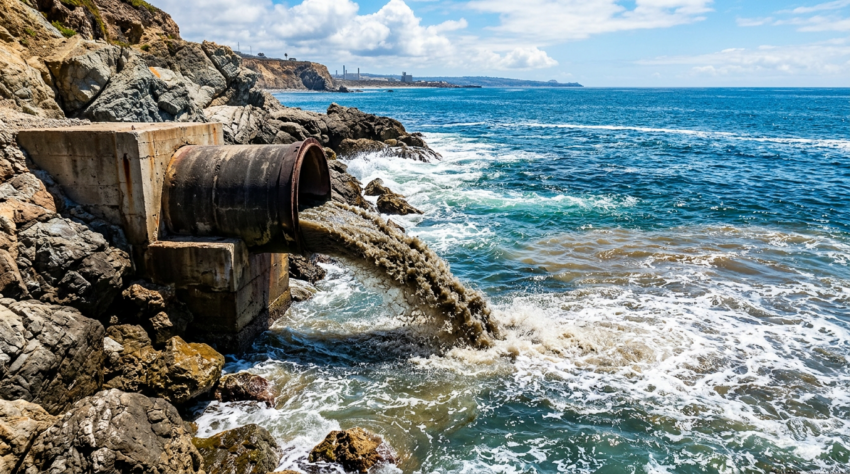
In 2025, water companies in England discharged raw sewage into rivers and along coastlines 291,492 times, for something on the order of 1.8 million hours. (See Note 1.) That figure was a third lower than the year before — but 2025 was the driest spring in over a century, which makes the volume of discharge more damning rather than less, since a great many of those spills occurred on dry days, when there was no storm overflow to excuse them. “Dry spilling” of this kind is illegal, and it is not a marginal abuse: the Environment Agency is now conducting the largest criminal investigation in its history, covering potential non-compliance at more than two thousand treatment works, and a record number of criminal investigations have been opened into individual companies. (See Note 2) Parliament has had to pass the Water (Special Measures) Act 2025 to make it possible to imprison executives who conceal illegal discharges. Thames Water, which serves a quarter of the country, was fined a record sum in 2025 and spent the first half of 2026 negotiating with its creditors to avoid the special-administration regime — that is, temporary renationalisation — that its own insolvency would otherwise trigger; the proposed rescue would reportedly have the regulator waive the company’s pollution fines until 2030. (See Note 3.)
I rehearse these facts not to score a point against privatisation as such — that is a separate argument — but to show what is at stake in the question Mazzucato leaves unasked. England did not drift into this condition. It legislated its way in, by deciding in 1989 that water was a private good, and it has spent a generation discovering that the decision was wrong. Sewage in the rivers is what an institutional misassignment looks like when you wade into it. A good that is, by any sensible reckoning, a local collective good — bound up with public health, with the shared use of rivers and coasts, with obligations to people not yet born — was placed in the private domain and managed for the extraction of dividends, and the externalities were dumped, quite literally, into the commons.
Notice what each framework can and cannot say about this. The old market-failure theory that Mazzucato rightly criticises can at least name the problem: sewage is a negative externality, and the regulator should price it. That is a thin response, but it is a response. Mazzucato’s own framework, which prides itself on moving beyond market failure to public value, has plenty to say about how a public-spirited water system ought to be governed once we have one — co-creation with citizens, transparency, reward-sharing — and nothing at all to say about the prior question of whether water should have been private in the first place. Her compass would help us steer a publicly-minded water company. It is silent on whether to have one. And the silence is not an oversight in the presentation; it is built into a framework that substitutes the language of values for the mechanics of assignment.
What an institutional theory supplies that a compass cannot
The lesson I draw is not that Mazzucato is wrong to want goods reconceived. It is that she has mislocated the reconception. The error in the orthodox taxonomy is not that it uses the wrong question — rivalry and excludability are perfectly good questions to ask about a good — but that it treats the answer as settling an institutional matter that only an institution can settle. The cure is not to swap one property (excludability) for another aspiration (public value). The cure is to recognise that the assignment of a good to the private or the collective domain is a legislative act, and to treat it as such: explicit, reasoned, accountable, and reversible.
That recognition does real work. It tells us where to look when things go wrong — not at the good, but at the statute. It tells us who is responsible — not the market, not some abstraction called “society”, but the legislature that drew the line. And it tells us what the remedy is — not a better attitude, but a better law. England’s sewage is not a failure of public value, nor a deficiency of stakeholder participation. It is a failure of assignment, written into the Water Act 1989, and it is correctable by the same instrument that created it. An institutional theory of collective goods makes that plain. A compass that points only at the “how” leaves the country circling the question it most needs to answer.
Mazzucato has spent her career insisting that markets are made, not found — that they are creatures of law and politics rather than facts of nature. She is quite right. It is a pity she did not extend the same insight to goods themselves, for it is there that it bites hardest. Goods, too, are made public or private; and the making is the most consequential economic decision a polity takes. A book about the common good that cannot tell us which goods to hold in common has, I am afraid, left out the part that does the governing.
Further reading and sources
R. P. Gilles, Economic Wealth Creation and the Social Division of Labour, Volume I: Institutions and Trust (Palgrave Macmillan, 2018), especially the treatment of legal systems, constitutions and government as institutional categories. See also my posts “Commodities I — What are they?” and “Commodities II — A property-based approach to economic goods” (The Relational Economy, 2020).
M. Mazzucato, The Common Good Economy: A New Compass (Allen Lane, 2026); and “Governing the economics of the common good: from correcting market failures to shaping collective goals“, Journal of Economic Policy Reform 27(1) (2024), pp. 1–24.
Notes
- Sewage discharges, House of Commons Library briefing CBP-10027; “UK Sewage Pollution Crisis: 300,000 Spills in 2025“, Natural World Fund.
- “Record 81 criminal investigations launched into water companies under Government crackdown“, GOV.UK.
- On the record fine and the creditor negotiations, see “Britain’s biggest water firm hit with record fine over sewage and dividends” and the We Own It campaign material on the proposed Thames Water deal.