On my new paper, “Second-Order Potentials for Finite Games: Existence, Characterisation, and Game Decomposition” (arXiv:2608.01967)
There is a small and very well-behaved class of games in which the entire strategic problem collapses into a single function. Instead of tracking what each of the players separately stands to gain or lose, one writes down one number for every combination of choices — the potential — and every player’s incentive to change her mind is read off that one function. These are the potential games, seminally introduced by Monderer and Shapley (1996) and anticipated in the congestion games of Rosenthal (1973).
The rewards for belonging to this class are considerable. A pure-strategy equilibrium is guaranteed to exist, because the potential must attain a maximum somewhere and nobody can improve on it. Better still, if the players simply keep switching to whatever currently suits them, the process must stop: each switch raises the potential, the potential takes finitely many values, and so the wandering terminates. Drivers choosing routes across a congested network do exactly this, which is why traffic models are the standard illustration.
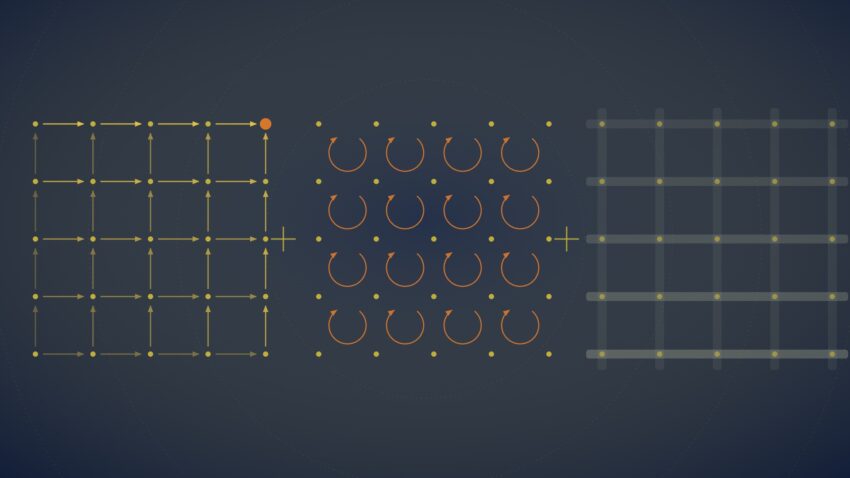
The difficulty is that almost no game is a potential game. The class is a thin sliver inside the space of all games, and one of the more productive responses to this awkwardness has been to stop asking whether a game is a potential game and start asking how much of one it is. Candogan, Menache, Ozdaglar and Parrilo (2011) — CMOP, in the abbreviation I use throughout — introduced a decomposition to split any finite game into a potential part, a harmonic part in which incentives circulate endlessly like matching pennies, and a non-strategic part that has no relevance in game play. The relative weight of the potential piece, a game’s “potentialness”, turns out to predict rather well whether simple learning algorithms converge or spin forever (Bichler et al., 2025). This is a genuinely useful thing to know, and it explains why the decomposition has attracted the attention it has.
Now, the CMOP construction is built on first-order information: what do I gain by switching my own action, holding everyone else fixed? That is the natural quantity to look at, and it is the one the machinery of discrete Hodge theory is built to handle. But the original Monderer–Shapley characterisation is not a first-order statement, but a second-order one.
Take two players, fix everybody else, and ask how my gain from switching changes when you switch. That number — the cross-difference — measures not my incentive but the interaction between our incentives, and the theorem says that a game is a potential game precisely when, for every pair of players, the two of us compute the same interaction. Note what this quantity throws away: it is entirely blind to how well off either of us is. Payoff levels vanish, individual tastes vanish, and what remains is the strategic coupling and nothing else.
The question I ask in this paper is the obvious one that nobody appears to have asked: what can be built from those cross-differences when they fail to agree, which is to say, almost always? At each pair of players there is a natural two-way split. Part of the interaction is felt identically by both — the common-interest part — and part is felt in exact opposition — the zero-sum part. The Monderer–Shapley theorem says that a potential game is one in which the second component is everywhere zero. My proposal is to keep the first component and throw the second away, and then to ask whether the surviving numbers can be integrated into a single function on the space of outcomes. If they can, I call the result an MS-potential.
The answer is more interesting than I expected. At the level of pairs, no obstruction arises at all: two players may disagree as violently as they like about their pairwise interaction, and the construction simply splits the difference. Every two-player game therefore has an MS-potential, as does every game in which players interact only in pairs. The trouble begins at three. When three or more players genuinely interact, the requirements imposed by the overlapping pairs can conflict, and the integration succeeds if and only if all the players involved in any such higher-order interaction experience it identically. This is a real condition and it does fail; I give a small three-player example in which it does. Where it fails, I fall back on a least-squares compromise, which always exists, is unique, and reduces to the exact object whenever the exact object is available.
The central result concerns what happens when one compares this second-order construction with the first-order one. Provided all players have the same number of actions, the two coincide: my MS-potential, once each player’s own individual effects are added back, is the CMOP potential, up to an additive constant to which any potential is indifferent anyway. Two constructions built from opposite ends of the problem — one minimising a least-squares misfit over first-order deviations, the other averaging second-order interactions — arrive at the same function. The practical consequence is the part I care about most. The CMOP potential is normally obtained by solving a large linear system over the entire space of outcomes. My identity shows that it is nothing more than a set of averages, taken interaction order by interaction order, and can therefore be written down in closed form with no system to solve at all. The speed-up is not marginal; it is the difference between solving and not solving.
I should be careful about how innovative this is, because parts of it are not. On the class of potential games itself, my construction reproduces what Sandholm (2010) and, before him, Ui (2000) already established, and I claim no originality for those steps. What is new lies entirely off that class: the extension of the potential concept to games that possess none, the identity with the CMOP potential and the closed form it delivers, and the decomposition of an arbitrary game into a common-interest MS-potential game plus a residual. Sandholm’s characterisation, elegant as it is, simply stops working outside the class of potential games, which is precisely where one wants an answer.
Three limitations deserve to be stated plainly rather than buried in a footnote. The first is that the identity holds only when the action counts are equal. When they are not, the CMOP and MS potentials diverge, and I establish no bound whatever on the divergence — indeed a single three-player game with two, two and three actions drives the relative discrepancy to infinity. The closed form off that diagonal is therefore an approximation of unquantified quality, and I would rather say so than let a reader discover it for himself.
The second concerns robustness, and here Abdou, Pin and Tsakas (2022) have already landed a blow on the CMOP decomposition that my construction only partially evades. They observe that duplicating an action changes nothing strategic yet moves the CMOP components substantially. My second-difference approach survives this test completely — duplicate a row of matching pennies and the record does not budge — but my least-squares extension does not, for the simple reason that averaging requires a measure on the action sets and duplication changes that measure. The dividing line runs straight through my own paper, separating the metric-free part of the theory from the calibrated part.
The third is a matter of interpretation. It would be a serious misreading to conclude that every game is nearly a potential game. My decomposition says the opposite. The MS-potential game is deliberately thin — it carries the strategic coupling and none of the players’ own payoffs — and the residual is correspondingly fat. What makes the thin object worth having is not that it is close to the original but that it costs almost nothing to compute and, with one simple augmentation, becomes the object that actually tracks equilibria.
Finally, the second-order reading is not a refinement of the first-order one but genuinely transverse to it. I construct a game that CMOP declares perfectly harmonic — potentialness exactly zero, no potential component at all — in which every single pairwise interaction nevertheless carries nonzero common-interest content. The two frameworks are reading different things.
Where this goes next is towards dynamics. Legacci and co-authors (2024) have shown that the harmonic class is exactly where exponential-weights learning is volume-preserving and recurrent, so a decomposition that separates a convergent part from a recurrent one is worth running learning algorithms on. That, together with the measure-theoretic apparatus, is the subject of companion work.
Further papers on this subject and related ideas will be made available here at my website in the future. For now, the paper is available here at my website on the game theory research page.