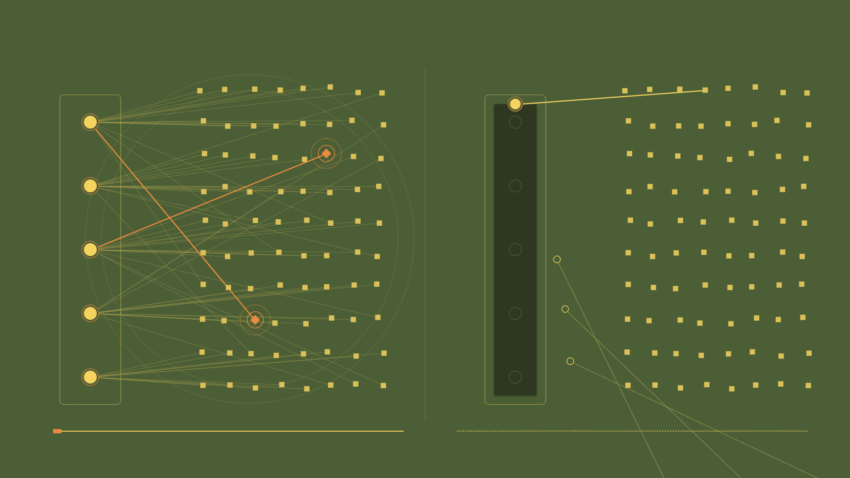
On 22 October 2026, Retraction Watch reported on a piece of software called EditorCheck.[^1] The tool is the work of Jules Di Scala, Guillaume Cabanac, Ophélie Fraisier-Vannier, Gilles Hubert and Paul Sabatier, together with Ronan Tournier of the Université Toulouse . It was presented a week earlier at the ACM/IEEE Joint Conference on Digital Libraries in Frisco, Texas.[^2] What it does is unglamorous to the point of banality. It reads, from a published paper’s metadata, the name of the editor who handled that paper; it then asks a citation database whether that editor had recently co-authored anything with any of the paper’s authors; and it compares the answer against the publisher’s own stated rule about how long an editor must wait before handling a collaborator’s work. Run across more than 340,000 papers published by PLOS and more than 172,000 published by MDPI, it flagged over 8,000 and roughly 2,500 respectively as breaches of those publishers’ own policies — PLOS forbidding a handling editor who has co-authored with an author within five years, MDPI within three.
The reporting treats this as a story about editors doing favours for their friends. I do not think it is. Dividing the flagged papers by the papers examined — which the coverage does not report, and which I therefore offer as my own — gives something near 2.4% at PLOS and 1.5% at MDPI. That is a low rate. It is low enough that the interesting question is not why so many papers were mishandled but why nobody noticed the ones that were, for years, until five computer scientists in Toulouse wrote some code against publicly available metadata. And that question has an answer which indicts economics far more comfortably than it indicts PLOS.
The answer is that the audit was possible at all only because PLOS and MDPI record who handled the paper. Economics journals, for the most part, do not. The rules that the economics profession has written for itself are therefore unenforceable. That is the argument of this essay.
The case for leaving editors alone
The position I am arguing against deserves to be put properly.
It runs as follows. Co-authorship within some window is a feeble proxy for a conflict of interest that actually distorts a decision. Fields are small; the people competent to evaluate a paper on, say, the core of a cooperative game are largely the people who have written on the core of a cooperative game, which is to say the people who have written with each other. A rule that recuses every editor who has recently collaborated with an author does not produce an impartial decision. It produces a decision by somebody less qualified to make it. There is evidence for exactly this: Fengyuan Liu, Bedoor AlShebli and Talal Rahwan, working across roughly half a million papers from the six publishers that do record handling editors, find not only that editor–author ties are associated with faster acceptance, but that forcing recusal tends to degrade the match between paper and replacement editor.[^3] They also find, in a survey experiment, that readers’ trust falls when an editor–author connection exists and recovers when that connection is disclosed. The implication is not that conflicts do not matter. It is that disclosure may do the work that recusal was supposed to do, at lower cost.
I have no quarrel with any of this, and a profession that recused on every tie would publish worse papers more slowly. The defence of editorial discretion is a real defence, and the honest version of it is that a journal is not a court: it is a curatorial institution whose quality depends on its editors knowing the field intimately, which is indistinguishable from their being embedded in it.
If economics had decided, openly, that editor–author collaboration is not a disqualifying conflict and that disclosure suffices, I would disagree in places but I could not complain of bad faith. That is not what economics has decided.
Economics publishes the verdict, not the judge
Consider the editorial policy of the American Economic Review, which I take as representative not because it is the worst but because it is among the most carefully drafted in the discipline. The coeditor in charge of a paper is required to recuse from submissions by current colleagues at the same institution, by graduate students at that institution, by untenured former students whom the coeditor advised, by family members, and — the relevant clause — by “coauthors of current papers or papers published less than two years ago”. A consulting coeditor faces a similar list with a three-year window for recently graduated advisees. Beyond the enumerated cases, the coeditor must disclose any other close personal or professional relationship that they believe creates a conflict.[^4]
This is a real rule with a real cooling-off window, shorter than PLOS’s five years but of the same kind. Now ask how compliance is established. The policy is admirably frank about it: “It is the responsibility of the coeditor to identify a conflict of interest to the editor.” There is a second line of defence, in that authors are asked during submission whether they are aware of any coeditor with a conflict. And that is the whole mechanism. Self-report by the person with the conflict, plus a question to the person with the most to gain from the conflict going unmentioned.
The obvious retort is that self-report is how most professional obligations work and that the absence of an audit is not evidence of its necessity. Quite so. The point is sharper than that. At PLOS, self-report was also the mechanism, and self-report was also assumed to be adequate, and then somebody checked and found ten thousand cases. The difference between PLOS and the AER is not that one has better rules or more scrupulous editors. The difference is that one of them publishes the name of the editor who handled the paper and the other does not, which means that the proposition “the AER‘s conflict rules are complied with” is not a claim anyone outside the AEA’s offices is in a position to evaluate. It is not false. It is unfalsifiable, which ought to be the more embarrassing condition.
There is a detail in the AEA’s own policy that makes the asymmetry almost poignant. When a coeditor or the editor submits a paper to the journal, a guest editor handles it, and the guest editor’s name appears in an acknowledgement footnote to the published article. The identity of the decision-maker is disclosed in precisely one circumstance: the case where the conflict was structural, unavoidable, and already known to everybody. In every other case — including every case where a handling editor might quietly have kept a collaborator’s paper — the name is withheld. The institution has grasped that naming the judge is what reassures the reader. It has then reserved the practice for the occasions when reassurance is least needed.
Three clever papers that should not have had to be clever
What makes me confident this is a metadata problem rather than a culture problem is the shape of the existing economics literature on it, which is a literature of ingenious workarounds.
Tommaso Colussi, in the Review of Economics and Statistics in 2018, studied the effect of social ties between editors and authors on what gets published, identifying those ties through shared institutional and doctoral histories rather than through any observed editorial assignment.[^5] Jonathan Brogaard, Joseph Engelberg and Christopher Parsons, in the Journal of Financial Economics in 2014, used the rotation of editors on and off boards as a source of variation, inferring editorial influence from the timing of who held office when.[^6] Raffaele Miniaci and Michele Pezzoni, writing in the Canadian Journal of Economics in 2020, approached editorship and social connections from a third direction.[^7] All three are good papers. All three are quasi-experimental, which is to say all three expend their cleverness on reconstructing, by inference, a fact that PLOS prints at the bottom of every article.
This is the cost of the missing field, and it is worth stating plainly because economists are usually alert to this sort of thing in every setting except their own. We are a profession that has spent four decades arguing that institutions should be designed so that the information needed to monitor them is generated as a by-product of their ordinary operation, rather than having to be assembled afterwards at great expense by somebody with a grant. We make this argument about procurement, about utility regulation, about the governance of firms. The social division of labour works, when it works, because specialised activity throws off observable traces that let the rest of us economise on trust. Our own journals have been built the other way round: the trace is suppressed, and the monitoring is left to whoever can afford the quasi-experiment.
Note what follows for the EditorCheck result itself. The 2.4% at PLOS is not a measurement of how dirty PLOS is. It is a measurement of what becomes visible when a publisher makes itself auditable. Economics has no corresponding number, and the temptation — I have heard it voiced — to read the absence of a number as the absence of a problem should be resisted by anyone who has ever taught selection bias to undergraduates.
What a name would cost
The remedy is embarrassingly easy. Publish, on each paper, the name of the editor who handled it. The code to check the consequences already exists, is open, and runs against a citation database the AEA can afford.[^8] Compliance with the two-year rule would become a fact about the world rather than an article of faith, and a profession that has built a reputation on refusing to take institutional claims on trust would have stopped making one glaring exception for itself.
I should concede what this costs, because the costs are not nothing. Named editors become targets, and the volume of correspondence from aggrieved authors is not a trivial burden on people already doing the work unpaid. In very small subfields, naming the handling editor narrows the referee pool to a guessable handful, which weakens the anonymity that the referees were promised rather than the one the editor was. And a published name invites exactly the naive inference the Liu, AlShebli and Rahwan survey picks up — readers discounting a paper for a tie that did the decision no harm at all. These are reasons to design the disclosure with care. They are not reasons to withhold it, and I notice that none of them is the reason usually given, which is that nobody has got round to it.
The larger point is the one I would want a reader to carry away. Integrity rules have two parts, the obligation and the apparatus that makes the obligation checkable. A discipline that writes the first without the second has not adopted a safeguard. It has issued a statement of intent. For as long as auditing was expensive, that was a defensible economy. Five people in Toulouse have now demonstrated that auditing costs a citation subscription and some patience, and the binding constraint has accordingly moved: it is no longer the cost of being checked but the willingness to be checkable. On that measure it is worth recording that PLOS, confronted with its own flagged cases, reassigned some of them and set its ethics team to examining around a hundred more, while MDPI asked to inspect the database first. Neither response is disgraceful. Both are the responses of publishers who had no choice, because the evidence was already public.
Economics has not yet been put in that position, and will not be until it prints a name.
[^1]: “Thousands of research studies violate journal policies on collaborations between editors and authors”, Retraction Watch, 22 October 2026, https://retractionwatch.com/2026/10/22/editorcheck-handling-editors-authors-collaboration-plos-mdpi-joint-conference-digital-libraries/. The figures quoted in this essay for papers examined and papers flagged are as reported there.
[^2]: Jules Di Scala, Guillaume Cabanac, Ophélie Fraisier-Vannier, Gilles Hubert and Ronan Tournier, “EditorCheck: Auditing editor–author conflicts of interests”, ACM/IEEE Joint Conference on Digital Libraries, 2026. Supplementary code and data are deposited at https://zenodo.org/records/21273293. Cabanac’s earlier work on the Problematic Paper Screener established much the same method in a different setting, which is to say that the technique here is not novel; its application is.
[^3]: Fengyuan Liu, Bedoor AlShebli and Talal Rahwan, “Current policies governing editorial conflicts of interest are ineffective”, arXiv:2307.00794 (2023; revised 2025). The paper’s three findings pull in different directions, and anyone citing it as straightforward support for tighter recusal rules has read only the title.
[^4]: American Economic Review editorial policy, https://www.aeaweb.org/journals/aer/about-aer/editorial-policy, consulted 27 October 2026. The quoted phrases are from that page. I have used the AER as an example rather than an offender; several economics journals have no published policy on editor–author collaboration at all, which is a worse position and a less interesting one to write about.
[^5]: Tommaso Colussi, “Social Ties in Academia: A Friend Is a Treasure”, Review of Economics and Statistics 100, no. 1 (2018): 45–50.
[^6]: Jonathan Brogaard, Joseph Engelberg and Christopher A. Parsons, “Networks and Productivity: Causal Evidence from Editor Rotations”, Journal of Financial Economics 111, no. 1 (2014): 251–270.
[^7]: Raffaele Miniaci and Michele Pezzoni, “Social Connections and Editorship in Economics”, Canadian Journal of Economics 53, no. 3 (2020): 1292–1317.
[^8]: I am describing the easy case. Reconstructing handling editors for papers already published would require the journals to open their records, which is a genuine request rather than a costless one. Everything in this essay concerns papers published from here on, where the marginal cost is one line in a footnote.